C; the question has two identical answers, it gets removed from the test based on that error
A crocodile has your toddler. It says it will return your child if you can guess its next move. What do you say?
“Holy fuck a talking crocodile‽”
Oof. Wrong time to get excited, buddy…
“It’s your responsibility now you scaly sucker!” and then voom off on my dune buggy. Also in this scenario I have a dune buggy for reasons.
Can I borrow your dune buggy?
Would like to borrow the buggy too.
Distract it while someone sedates/shoots/whatevers it…
Even if you guess the move, it doesn’t say it’ll be alive or intact, so the safest thing to do is not to play.
“NOW YOU DIE, CROCODILE” as my drone army attacks
Lmao that’s fucked up hahaha
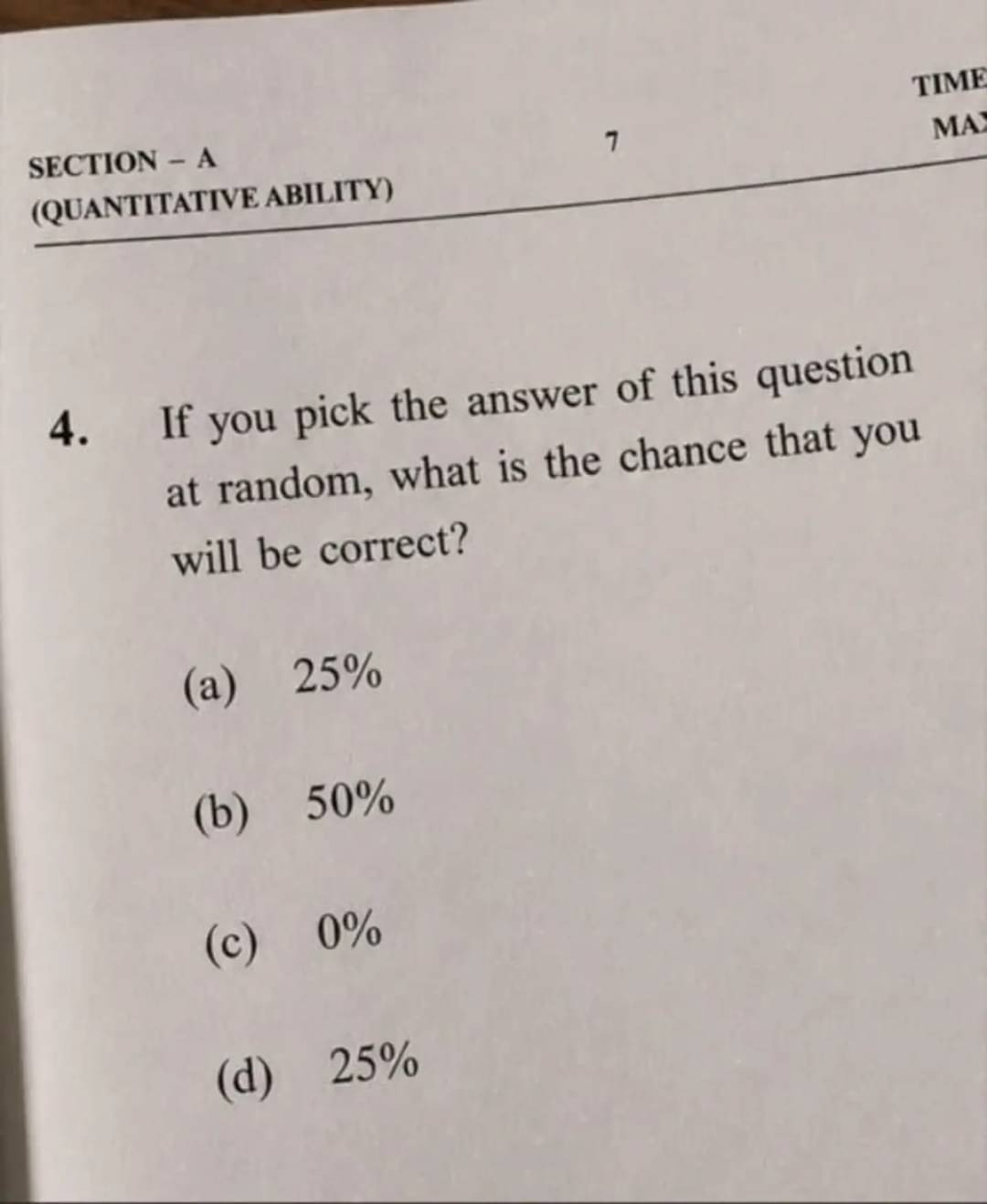
It’s B - 50%; either correct (50%) or false (50%), binary 0/1, yes/no, score or not.
There is no correct answer. The reason why there’s no correct answer is that it’s a self-referential paradox, but imagine you saw this:
What is 1+1?
A) 9
B) π
C) 76
D) Syria
There’s no correct answer, so it’s not a valid multiple choice question.
Can’t be 25% = it could be correct if the “other 25%” was 24 or 26 (or even 25.000001). Since there are two 25%, the 25% change is raised, nullify the 25% prediction. Can’t be 50%, because there are other two different options in addition to fifty in fifty-fifty; so 50% (or fifty-fifty) don’t exist as option.
Can’t be 0%, because 0% is a very specific assertion that can’t ever be true due to paradox (if you “guessed”, you nailed it 100%)
Result: malformed question, no one is valid… The best you can have is 25%, which is still wrong, but I thing is the closer to approximate. Ideally the question would reform as:
Option A: 25% Option B: 50% Option C: 0%
=33.3~%
Answer can be a,b,c or d. So could be a or d. Pick one at random and you have a 50% chance.
The answer is null because the question references information that we don’t have. It can’t be answered.
Not quite. All information is present, but the answer changes in a way that makes this unanswerable.
The question asks “What is the likelihood that you will give the correct answer to this question?” But does not detail the question that it is asking.
As a hypothetical, if I came up to you and said
“What is the answer to my question?”
There are a number of ways you could answer, such as saying “What question?” Or even just “I don’t know”. But the fact of the matter is that you cannot give a knowledgeable answer in earnest because the question I gave you is malformed and lacking information.
Like, I get the point of the question pictures, it’s a very funny “haha look at this mathematical conundrum, isn’t that pretty funny guys?” And it’s a good question for that
But I guess I’m just being a buzzkill by saying that technically none of these answers is correct because the premise of the question itself relies on a language error. Idk
“This question” means “the current question being g asked” and trying to argue otherwise is just silly. The only way you could be confused in that is if you’re not a native English speaker (and if you’re not, fair enough). My point being, you are given the full question, the question being referenced, and the possible answers.
It’s unanswerable not because of a language error, it’s because the second 25% makes it impossible to correctly answer as the answer is essentially a mathematical paradox. All answers are simultaneously correct and incorrect.
I am a native English speaker with a very good comprehension of the language.
So let’s walk through the logic then, follow me on this one.
I walk up to you and ask
“What is the answer to my question?”
I claim you have been given full information as to what the question is, and you are able to knowingly answer it without saying “I don’t know” or “What question?”
How do you answer?
The question pictured is not “my question” it is “this question” you can’t change the language of the question then complain it means something it doesn’t.
So, syntactically speaking “My” question vs “this” question doesn’t actually change anything about the example that I’m making. If making my example analogy closer to the question in the picture will help you understand the point, I can do that too, no worries.
So, let us word it like this then
“Is the answer to this question a bear, a moose, a lion, or a tiger?”
The question fails before it reaches the stage where an answer is chosen, because the question is not formatted correctly. It is nonsensical to attempt to determine which of the four animals is the answer to the question, because the question is a nonsense question.
In the same way, while it is a clever way to set up a question to imply a paradox, while it is a very fun way to contemplate how the answer might change given how the ‘correct’ answer changes based on which answer you choose; the reality of the situation is that the question actually fails before reaching the ‘choose an answer’ stage of the problem, because the self-referential language makes the question itself nonsensical.
Is that clearer?
🤦♂️
You’re telling me that if the answer choices were 0%, 25%, 50% and 100% this question would be impossible to answer because it was formatted incorrectly?
It’s a malformed question that cannot be answered
Too bad Wrath of Math is probably not on here
Diabolical
I love this.
C, if there is a requirement to show your work and random guesses that don’t show work get no credit.
deleted by creator
C: 50%, you have a 1 in 4 (25%) chance of guess the correct answer but there are two correct answers so 2 in 4 = 50%.
I would answer 0%.
You say the answer is 50%. So 25% is not the right answer to the question, right? So you only have 25% chance of randomly selecting 50%, and therefore, 50% is the wrong answer.
So the answer is 25%, but you have 50% chance of picking 25%, so it’s wrong again.
You can’t solve it: the answer is 0%.
But that would mean 0% is the correct answer.
So theres a 25% chance of picking 0% as the correct answer.
The correct answer changes depending on what answer you picked.
Its a Schrodingers probability question.
If 0% is not the right answer, that confirms that no matter what you pick at random, this is not the right answer: your chances of picking it are 0.
As much as you can loop to demonstrate the other answers are all wrong, you demonstrate 0 is the correct answer by a loop also.
You didn’t follow what that means though. If 0% is the correct answer, a random guess has a 25% chance of hitting it. It loops.
Therefore 0 is not the right answer, and your chances of picking the right answer are 0.
It also loops, positively this time.
deleted by creator
deleted by creator
This. I.e., there is no correct answer.
Sooo, C?
if c was correct then it would be 25% then 50% and then 25% again ans 50% and 25%
Write -in, E, none of the above
E) actual 0%, the above C is a null value incorrectly written as a numeric 0%
The answer “there is no correct answer” is correct, but the answer isn’t 0%. It’s a paradox. There isn’t a solution, which isn’t the same thing as saying there’s a 0% chance of getting the right solution (when that is one of the choices).
Essentially there’s a difference between “0% of answers will be correct (because none can be)” and “the listed 0%-option self-invalidates if selected”. The problem is the interaction between answers that shouldn’t be there in normal tests, which changes the values after selection.
Therefore, the only winning move is not to play.
Well I’m not picking it at random, so C is correct.
If c is correct for you then it’s also correct for those who answered at random. And if it is, then you’re all wrong because you’re answering about those who answered at random.
The only viable approach to actually answer is to argue that the question is ambiguous and that while the hypothetical test takers face infinite recursion you the real test taker don’t have to resolve the infinite recursion and to then choose a place to halt evaluation. And if they disagree then your solution to the Halting problem invoke the all powerful oracle function “I’ll talk to the principal”.
It’s not necessary to use recursion. Simple logic solves it. If a or c are true, that implies a and c are not true. If b is true, that implies b isn’t true. If d is true, that implies d isn’t true. No recursion needed and this is complete. You could take a recursive approach, but it doesn’t halt, like you said, so it doesn’t give a result.
(Also, the halting problem is determining if something halts, not what the value is at the end. This problem does not halt, if done recursively. The halting problem is easy to resolve for this particular problem.)

False