The answer “there is no correct answer” is correct, but the answer isn’t 0%. It’s a paradox. There isn’t a solution, which isn’t the same thing as saying there’s a 0% chance of getting the right solution (when that is one of the choices).
Essentially there’s a difference between “0% of answers will be correct (because none can be)” and “the listed 0%-option self-invalidates if selected”. The problem is the interaction between answers that shouldn’t be there in normal tests, which changes the values after selection.
If c is correct for you then it’s also correct for those who answered at random. And if it is, then you’re all wrong because you’re answering about those who answered at random.
The only viable approach to actually answer is to argue that the question is ambiguous and that while the hypothetical test takers face infinite recursion you the real test taker don’t have to resolve the infinite recursion and to then choose a place to halt evaluation. And if they disagree then your solution to the Halting problem invoke the all powerful oracle function “I’ll talk to the principal”.
It’s not necessary to use recursion. Simple logic solves it. If a or c are true, that implies a and c are not true. If b is true, that implies b isn’t true. If d is true, that implies d isn’t true. No recursion needed and this is complete. You could take a recursive approach, but it doesn’t halt, like you said, so it doesn’t give a result.
(Also, the halting problem is determining if something halts, not what the value is at the end. This problem does not halt, if done recursively. The halting problem is easy to resolve for this particular problem.)
Thus the joke form, using the principal as a Halting oracle (going up a hierarchy (of complexity)), phrased such that it allows you to select an answer as correct rather than leaving it undecidable


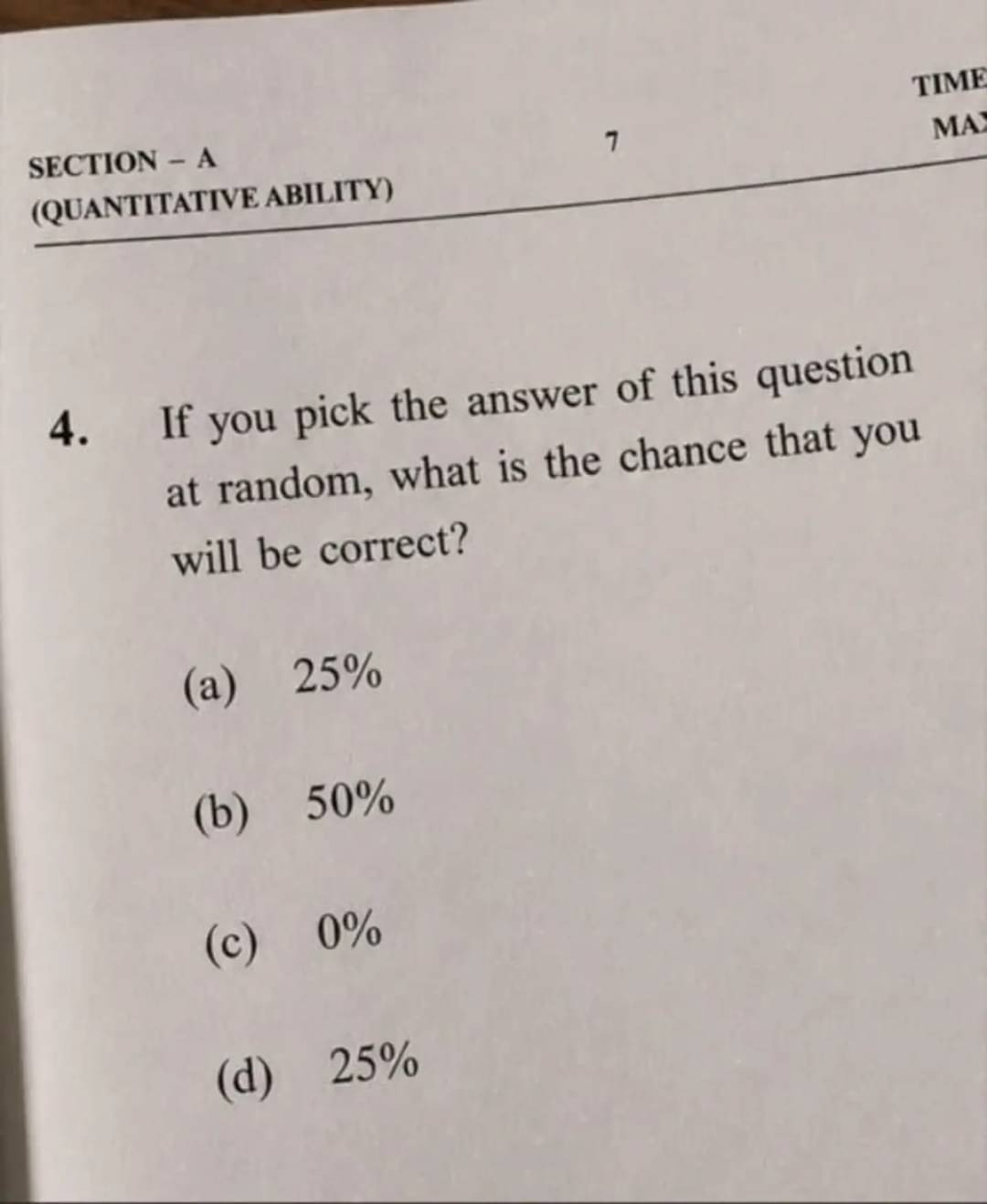
This. I.e., there is no correct answer.
Sooo, C?
if c was correct then it would be 25% then 50% and then 25% again ans 50% and 25%
Write -in, E, none of the above
E) actual 0%, the above C is a null value incorrectly written as a numeric 0%
The answer “there is no correct answer” is correct, but the answer isn’t 0%. It’s a paradox. There isn’t a solution, which isn’t the same thing as saying there’s a 0% chance of getting the right solution (when that is one of the choices).
Essentially there’s a difference between “0% of answers will be correct (because none can be)” and “the listed 0%-option self-invalidates if selected”. The problem is the interaction between answers that shouldn’t be there in normal tests, which changes the values after selection.
Therefore, the only winning move is not to play.
Well I’m not picking it at random, so C is correct.
If c is correct for you then it’s also correct for those who answered at random. And if it is, then you’re all wrong because you’re answering about those who answered at random.
The only viable approach to actually answer is to argue that the question is ambiguous and that while the hypothetical test takers face infinite recursion you the real test taker don’t have to resolve the infinite recursion and to then choose a place to halt evaluation. And if they disagree then your solution to the Halting problem invoke the all powerful oracle function “I’ll talk to the principal”.
It’s not necessary to use recursion. Simple logic solves it. If a or c are true, that implies a and c are not true. If b is true, that implies b isn’t true. If d is true, that implies d isn’t true. No recursion needed and this is complete. You could take a recursive approach, but it doesn’t halt, like you said, so it doesn’t give a result.
(Also, the halting problem is determining if something halts, not what the value is at the end. This problem does not halt, if done recursively. The halting problem is easy to resolve for this particular problem.)
Thus the joke form, using the principal as a Halting oracle (going up a hierarchy (of complexity)), phrased such that it allows you to select an answer as correct rather than leaving it undecidable
https://en.wikipedia.org/wiki/Turing_jump
No need for the oracle to actually be correct in the joke form btw
False