You can’t separate the question like that. Whichever answer you circle indicates your assertion that this is the probability of getting the correct answer by uniform random chance.
This means that any answer you circle is wrong, and so the correct answer is to not circle any of them. You could even write e) none of the above to indicate that you have deliberately chosen not to circle one of them instead of skipping the question.
I have had plenty of exams with multiple choice questions that included the possibility of no correct answers, one correct answer, or even multiple correct answers, and we were expected to make that judgement (rather than blindly follow instructions).
They’re called multi-select questions and you’re warned about them by the professor ahead of time. Sometimes they have a “none of the above” option but sometimes they don’t.
The purpose is to get you to think critically. If you look at a question and all of the options seem wrong to you, making a guess because “one of them has to be right, it’s multiple choice” is lazy thinking and has nothing to do with the subject matter. In real life you don’t have the luxury of knowing that there’s one correct answer among a set of options.
The purpose of an exam is to test your knowledge of the course subject, not to test your ability to take multiple choice tests. Sometimes that’s hard to separate out, but the standard multiple choice question (where one and only one answer must be correct) is very game-able by guessers who don’t know the subject very well and risks the possibility of someone getting very lucky while not knowing anything.
Well, I suppose I fell into the trap of thinking that questions with no right answers meant nobody could get a perfect score, but I would imagine that 1) it’s fair across the board and 2) accounted for in the scoring somehow.
I suppose I was always a fan of taking easy multiple choice tests as a student - some people write them such that by using the tiniest amount of logic, someone with zero knowledge of the subject could still probably ace them, versus someone writing a diabolical one that dives deep into the subject matter and has answers that are very very slightly different and you really do have to know the material strongly to have any hope. lol. But taking a diabolical test where some questions don’t have ANY correct answers would be even MORE satisfying to ace if you really do know the material well enough, so that sounds like fun. :)


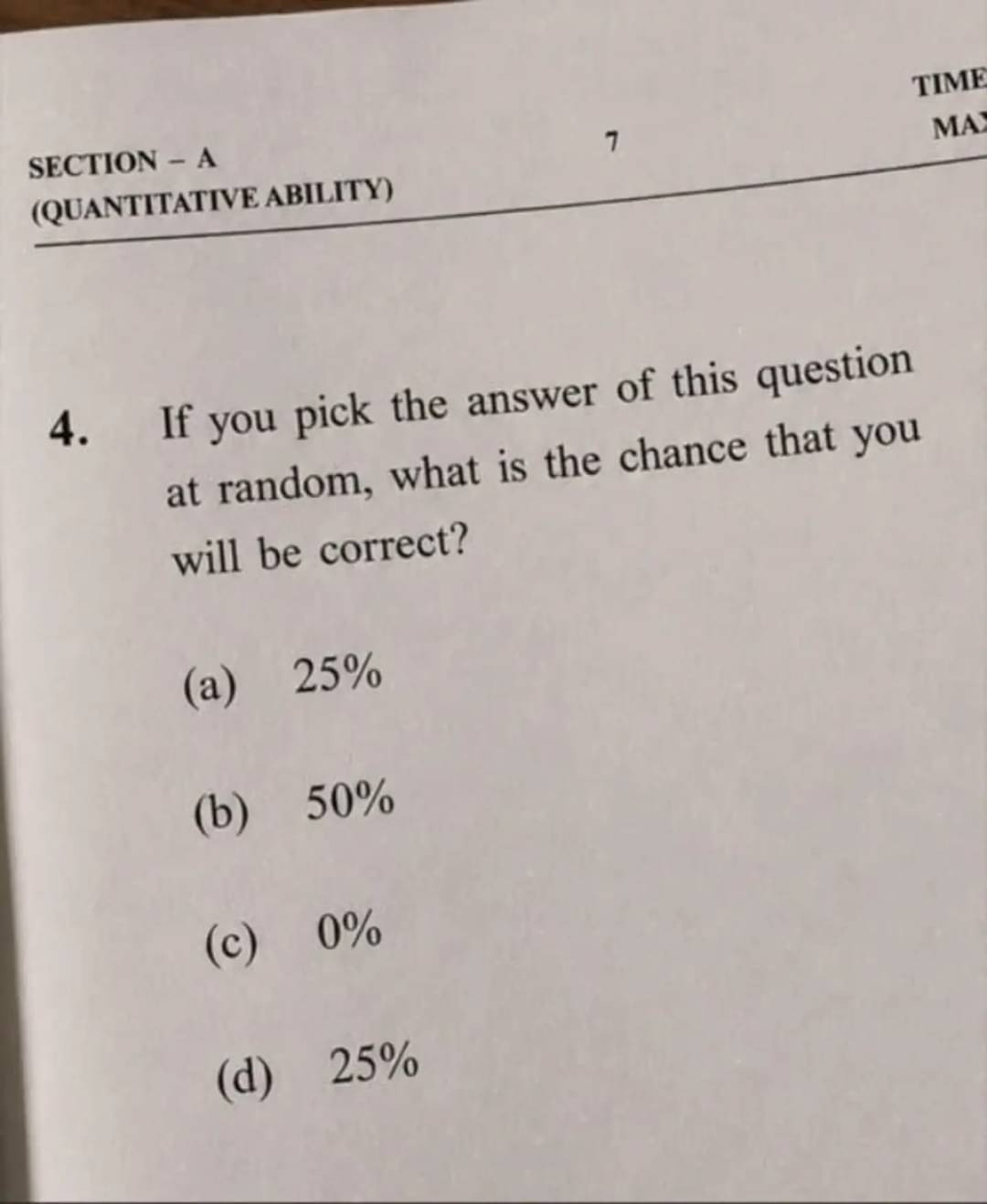
You can’t separate the question like that. Whichever answer you circle indicates your assertion that this is the probability of getting the correct answer by uniform random chance.
This means that any answer you circle is wrong, and so the correct answer is to not circle any of them. You could even write e) none of the above to indicate that you have deliberately chosen not to circle one of them instead of skipping the question.
I have had plenty of exams with multiple choice questions that included the possibility of no correct answers, one correct answer, or even multiple correct answers, and we were expected to make that judgement (rather than blindly follow instructions).
The answer is 0%: no matter what you chose, it’s wrong. Therefore, at random, you have 0% chance of picking the right answer randomly (or not).
If your chance of getting the right answer is 0%, then the right answer is © 0%, giving you a 1/4 or 25% chance of being correct, thus the answer cannot be 0%.
0 not being the correct answer, your chances of picking the correct answer at random are 0.
Which makes 0 the correct answer, contradicting the assumption that 0 is not the correct answer.
What multiple choice test includes questions with no correct answer? That seems stupid to me.
They’re called multi-select questions and you’re warned about them by the professor ahead of time. Sometimes they have a “none of the above” option but sometimes they don’t.
The purpose is to get you to think critically. If you look at a question and all of the options seem wrong to you, making a guess because “one of them has to be right, it’s multiple choice” is lazy thinking and has nothing to do with the subject matter. In real life you don’t have the luxury of knowing that there’s one correct answer among a set of options.
The purpose of an exam is to test your knowledge of the course subject, not to test your ability to take multiple choice tests. Sometimes that’s hard to separate out, but the standard multiple choice question (where one and only one answer must be correct) is very game-able by guessers who don’t know the subject very well and risks the possibility of someone getting very lucky while not knowing anything.
Well, I suppose I fell into the trap of thinking that questions with no right answers meant nobody could get a perfect score, but I would imagine that 1) it’s fair across the board and 2) accounted for in the scoring somehow.
I suppose I was always a fan of taking easy multiple choice tests as a student - some people write them such that by using the tiniest amount of logic, someone with zero knowledge of the subject could still probably ace them, versus someone writing a diabolical one that dives deep into the subject matter and has answers that are very very slightly different and you really do have to know the material strongly to have any hope. lol. But taking a diabolical test where some questions don’t have ANY correct answers would be even MORE satisfying to ace if you really do know the material well enough, so that sounds like fun. :)